CRM for Building & DIY Manufacturers: Equipping Sales Agents in DIY Retail and Builders' Merchants
As a manufacturer in building, finishing trades, construction, or DIY, your distribution network relies on independent multi-line sales agents who juggle two demanding channels every day: builders' merchants and DIY retail chains (such as Leroy Merlin, Castorama, and Brico Dépôt). Finding the right building industry CRM — one your agents willingly adopt because it genuinely helps them in the field — is one of the most important decisions you can make for your network's performance.
Updated September 2026 — by the KepleR team, French publisher of CRM software for multi-line sales agents.
The sector remains under pressure: according to the Fédération Française du Bâtiment (FFB), building industry turnover fell by 4% in 2024, while the DIY market dropped back below €40 billion (source: Xerfi, 2025). In this context, every field visit counts. Your agents cannot afford to be imprecise: a wrongly audited shelf, an unreported stock-out, a retail banner price incorrectly applied — and your product listing is at risk. Software adapted to the reality of building and DIY retail field work is no longer a luxury; it is a competitive lever.

KepleR is a sales agent software that building manufacturers deploy to their agents, in DIY retail as well as builders' merchants.
The field realities of building and DIY manufacturers that your CRM must understand
Distributing building, finishing trade, or tools products through a network of multi-line sales agents means dealing with constraints that generalist CRMs almost invariably overlook.
A dual network with opposing logics
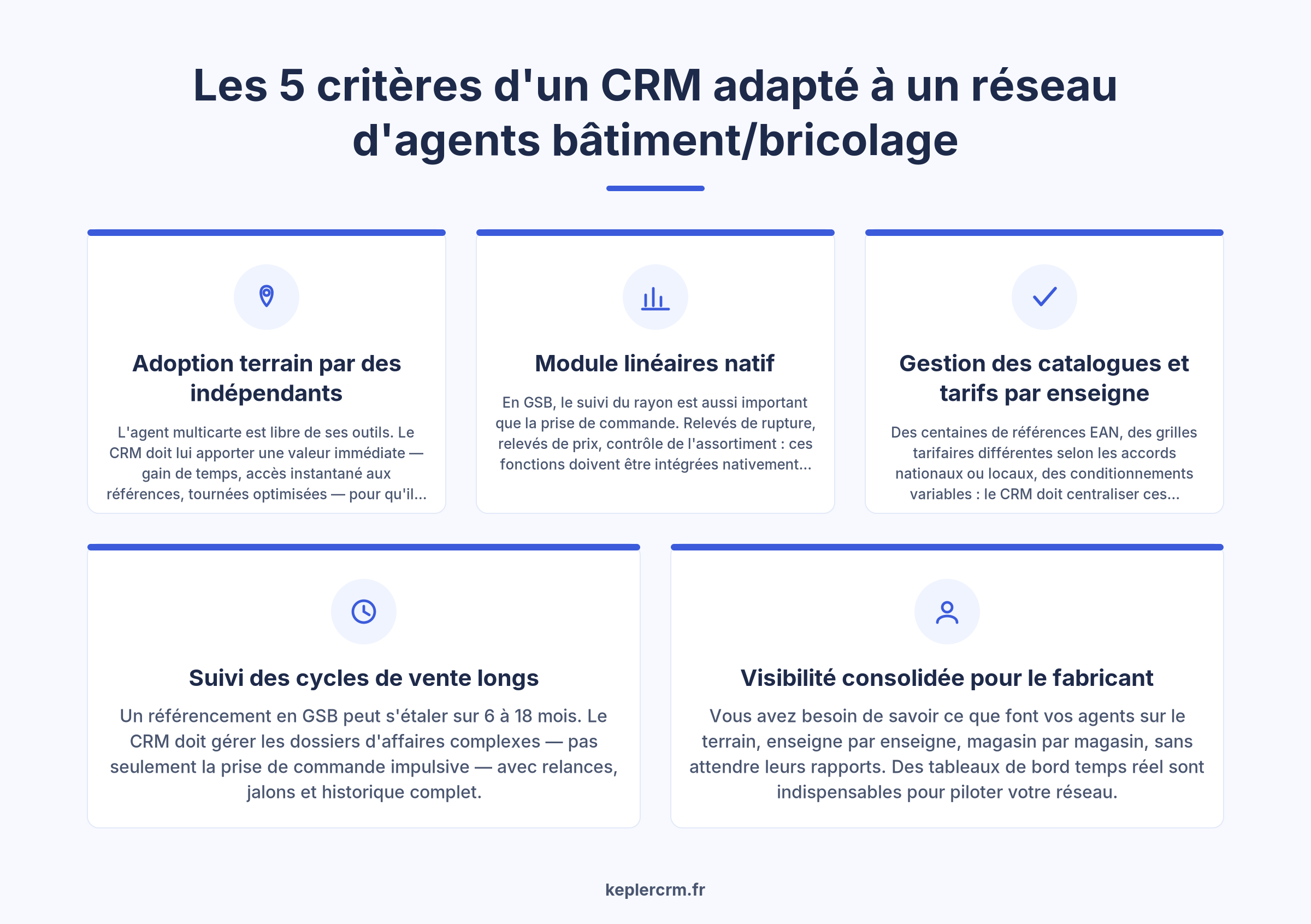
Your agents visit both builders' merchants — technical contacts, project-based purchasing, long-term relationships with the owner or department manager — and DIY retail chains (Leroy Merlin, Castorama, Brico Dépôt, Mr.Bricolage…), where the logic follows that of mass retail: national buying groups, local store agreements, management of shelf space and product availability. According to the Xerfi study (2025), four groups account for 97.5% of the DIY retail market in France. Few key decision-makers, but very high field demands. Your CRM must allow your agents to switch between these two environments without friction, with the right context, the right prices, and the right tasks for each type of client.
Large technical catalogues and retail-banner-specific pricing
In building and DIY, your ranges often include hundreds or even thousands of references with EAN codes, technical data sheets, pack sizes, and differentiated prices depending on national or local agreements. Your CRM must carry this data and make it instantly accessible to the agent, including during order taking on the shop floor. A tool capable of scanning EAN barcodes directly from a tablet or smartphone eliminates data-entry errors and speeds up order placement — a tangible benefit your agents appreciate immediately.
Construction seasonality and long listing cycles
Activity varies with the seasons: construction projects accelerate in spring and summer, while DIY retail chain range reviews follow their own calendar. A listing in a DIY chain can take between 6 and 18 months from first contact to actual shelf presence. Your CRM must therefore handle both immediate order taking at builders' merchants and long-cycle business tracking — listing negotiations, follow-ups, range review deadlines — so that no agent misses a critical step for lack of the right tool.
For further guidance on the equipping process, see the guide to equipping sales agents as a manufacturer.
Shelf audits in DIY retail: a task your CRM cannot ignore
In DIY retail chains, maintaining your products' physical presence on the shelf is an ongoing battle. Stock-outs, poor shelf positioning, a competitor's reference encroaching on your linear metres, a displayed price not compliant with the chain agreement: these are situations only an agent on site can detect — provided they have the right tool to report and document them.
What a shelf module must cover
- Stock-out reporting: the agent flags missing references in real time, with photos if needed, to trigger a restock or an alert on the manufacturer's side.
- Price checking: verification that the displayed price matches the national or local agreement, and detection of competitive price gaps.
- Assortment audit: check of the presence of every reference listed in the chain contract, with a compliance rate calculated automatically.
- Shelf performance analysis: tracking shelf space evolution over time, store by store, to prioritise your visit schedules.
KepleR includes a native full shelf audit module covering all of these needs. Find the full detail in the section dedicated to KepleR for agents in grocery and DIY retail.
Generalist CRM vs specialist building and DIY field CRM
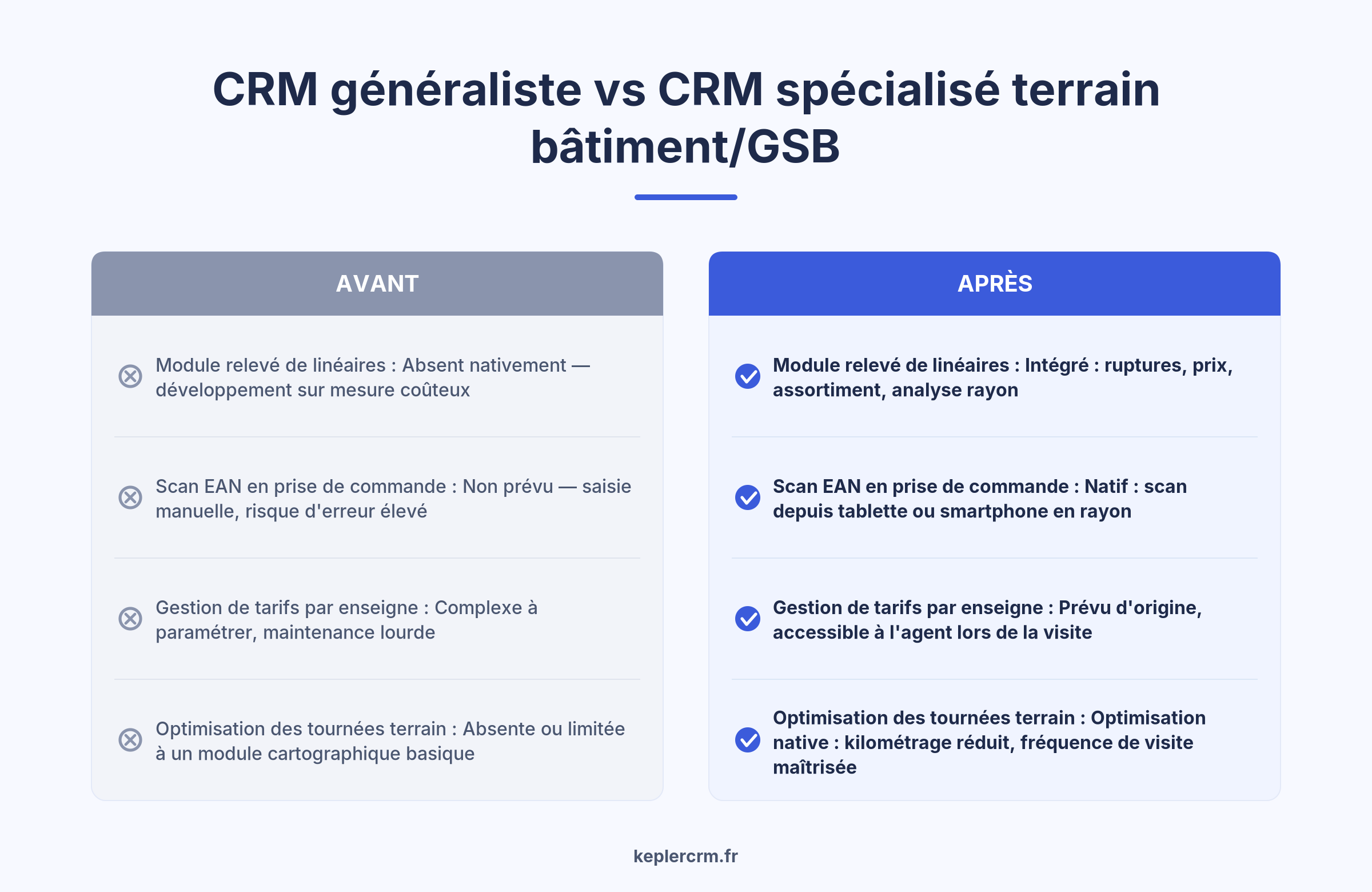
| Criterion | Generalist CRM | Specialist field CRM (KepleR) |
|---|---|---|
| Shelf audit module | Not available natively — costly bespoke development required | Built in: stock-outs, prices, assortment, shelf analysis |
| EAN barcode scanning for order taking | Not provided — manual entry, high error risk | Native: scan from tablet or smartphone on the shop floor |
| Retail-banner-specific pricing | Complex to configure, heavy to maintain | Built in from the outset, accessible to the agent during the visit |
| Field route optimisation | Absent or limited to a basic mapping module | Native optimisation: reduced mileage, controlled visit frequency |
| Adoption by independent agents | Designed for employed teams — heavy rollout, low adoption | Mobile-first field ergonomics, immediate value for the agent |
Why a generalist CRM is not enough for a building and DIY sales agent network
It is tempting to rely on a CRM already in use within your company — Salesforce, HubSpot, or an ERP with a built-in CRM module. These tools are designed for inside sales teams or classic B2B sales cycles. They have several structural limitations for a field sales agent network in the building sector:
- No shelf audit module: stock-out reporting, price checking, and assortment audits in DIY retail are simply not part of their DNA. Costly adaptations are required, and these are often poorly adopted in the field.
- Catalogues and pricing are difficult to manage: importing and keeping thousands of EAN references up to date with retail-banner-specific price grids exceeds the native capabilities of these tools.
- No route optimisation: an agent covering a region with 80 builders' merchant and DIY retail outlets needs a tool that optimises their travel — not a CRM that forces them to enter their schedule manually.
- Difficult adoption by independent agents: a multi-line sales agent is not an employee. They are under no obligation to use a tool you impose on them. If they find it too cumbersome or ill-suited to their daily field reality, they will not use it — and you will lose all visibility.
For a comprehensive and objective overview, see the comparison of software for multi-line sales agents.
KepleR: the building and DIY industry CRM designed for the field
KepleR is a building and DIY industry CRM designed around field realities: independent multi-line sales agents, dual builders' merchant and DIY retail networks, large technical catalogues, seasonality, and long sales cycles. Here is what it concretely brings to your network:
For your agents in the field
- Available everywhere: Web, iPhone, iPad, Android, Mac, and Windows — agents work from the device they already use, with no hardware constraints.
- Order taking with EAN scanning: fast and accurate order placement on the shop floor, with no reference errors.
- Native shelf audit module: stock-out reporting, price checks, and assortment audits directly from a tablet or smartphone in-store.
- Optimised call plans: organisation and optimisation of visits to reduce mileage and ensure every client is visited at the right frequency, based on potential and visit agreements.
- Long-cycle business tracking: management of DIY retail listing negotiations, follow-ups, milestones, and exchange histories — not just immediate order taking.
For you, the manufacturer
- Real-time visibility: consolidated dashboards by agent, by retail banner, by region — you know what is happening on the shelf without waiting for the end-of-week report.
- Retail-banner-specific pricing: national and local agreements integrated and accessible to the agent at the point of ordering or shelf auditing.
- Suited to all profiles: from a sole trader agent to a large multi-line sales agency, across all segments of building, finishing trades, tools, and DIY.
Discover KepleR on video: KepleR tools overview.
Watch KepleR in action

Frequently asked questions
How can I monitor what my agents are doing in DIY retail stores if I cannot impose my CRM on them?
This is the central question in managing a network of independent agents. The answer is not imposition but added value: a CRM that your agents adopt because it makes their work easier — EAN scanning, quick shelf audits, optimised call plans — naturally generates data that feeds back to you in real time. The less burdensome the tool is for them, the more visibility you gain. Request a KepleR demo to see concretely how this model works.
My network covers both builders' merchants and DIY retail chains. Can a single CRM handle both channels?
Yes, provided the CRM is designed for it. You need separate client records by distributor type, price grids by retail banner or local agreement, and different field tasks depending on the channel (order taking at builders' merchants, shelf audits in DIY retail). KepleR handles both logics natively within a single tool, without the need to maintain two separate databases.
My ranges include hundreds of EAN references with different prices depending on the retail chain. How can a CRM manage this?
A specialist field CRM such as KepleR is designed to integrate large catalogues with EAN references, pack sizes, and prices differentiated by retail banner or agreement. The agent is automatically presented with the correct price grid during their visit, which prevents billing errors and disputes. Contact us for a demo based on your own catalogue.
Our DIY retail listing cycles can last more than a year. Can a field sales agent CRM track these long-running files?
Yes. KepleR is not purely focused on quick order taking. It includes long-cycle business tracking: negotiation milestones, exchange history, planned follow-ups, and listing status by retail banner. Your agents can manage an immediate order at a builders' merchant just as effectively as a multi-year listing file with a DIY retail buying group.
Can I use a generalist CRM such as Salesforce or HubSpot to manage my building industry sales agents?
These tools are powerful for inside marketing teams or classic B2B sales forces, but they are not designed for building and DIY retail field work: no shelf audit module, no native EAN scanning, no route optimisation, and a rollout process that is often too heavy for independent agents to adopt. The cost of customising them to meet your needs typically exceeds that of a specialist tool. See the detailed comparison to make an informed choice.
Equipping your agents: let's talk
Every agent network is different. The simplest approach is to discuss your organisation, your sectors, and your product ranges: we will show you concretely, during a demo, how KepleR adapts to your network — and we will put together a quote based on your number of agents.