French food & drink in 2026: a sector under pressure going digital
A food & drink CRM is now a practical working tool for sales agents and sales representatives covering grocery retail, wholesalers, and foodservice. To understand why, it helps to look at the sector and its recent changes.
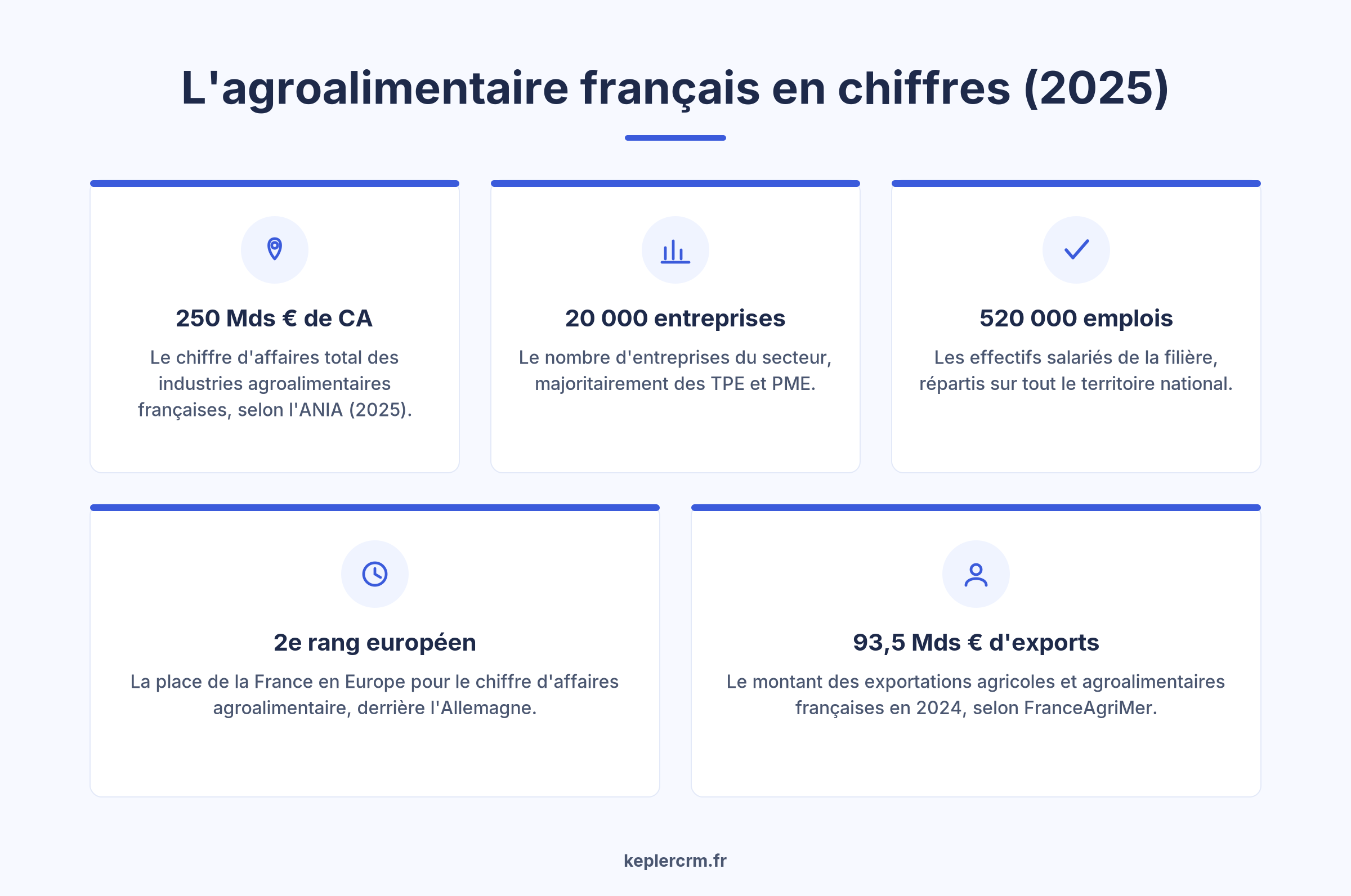
According to ANIA (2026), the French food and drink industry comprises 23,000 businesses, employs 520,000 people, and generates €250 billion in revenue — making it the country's largest industrial sector. France ranks sixth among the world's exporters, according to FranceAgriMer. These are enormous volumes — and behind every shelf listing, there is a field sales agent.
Market conditions are nonetheless toughening. According to Agreste (2026), France's food and drink trade surplus had fallen to around €200 million in 2025, down from €5 billion in 2024, driven by an 8% rise in imports and trade tensions in wine and spirits. ANIA describes the situation as an "industry at breaking point": one in four food businesses is operating at a loss. Margins are squeezed, retail chains are negotiating harder, and principals expect reliable, timely field reports.
Why food & drink field sales is a category of its own
A sales agent in the food and drink sector is not a standard B2B salesperson. They manage several principals, multiple product ranges, and hundreds of sales points simultaneously — with constraints that simply do not exist in other sectors.
The first characteristic: recurrence. Unlike a long sales cycle, a grocery sector manager or food and drink sales representative must return to each store regularly to defend shelf space, check for out-of-stocks, monitor prices, and verify facings. A missed visit can mean a product disappearing from the shelf.
The second characteristic: pricing complexity. Conditions vary by retail banner, promotions follow one another in quick succession, and own-label competitors keep gaining ground. The agent must have — or be able to access on a tablet — the right price for the right customer at the right time.
The third characteristic: multi-channel complexity. Grocery retail (GMS), wholesalers, foodservice (RHF), delicatessens… each channel has its own rules, its own contacts, and its own margin levels. Juggling these worlds without a structured tool means navigating blind.
Digitalisation: what it means for food & drink sales teams
Digitalisation is accelerating across the sector. The NUM-ALIM project is pushing industry players to share nutritional and environmental data in digital formats. Retail chains, meanwhile, are demanding increasingly structured product data — labelling, composition, origin.
For the sales agent, this translates into a growing requirement for precision and traceability in every interaction with a buyer or category manager. Arriving at a visit without the account history, without sell-out data, or without an up-to-date catalogue has become a real competitive disadvantage.
The shelf audit illustrates this transformation well. Traditionally carried out on paper or in a spreadsheet, it can now be completed directly on the shop floor from a mobile app, with automatic data compilation: observed prices, number of facings, detected out-of-stocks, point-of-sale materials in place. This connected approach significantly reduces data-entry errors and makes the information passed back to principals more reliable.
The result: principals working with agents who use a food & drink CRM receive more reliable, more frequent reports, and can adjust their commercial strategy accordingly. The agent who equips themselves becomes a strategic partner — not simply an order taker.
What this means in practice for you as a food & drink sales agent
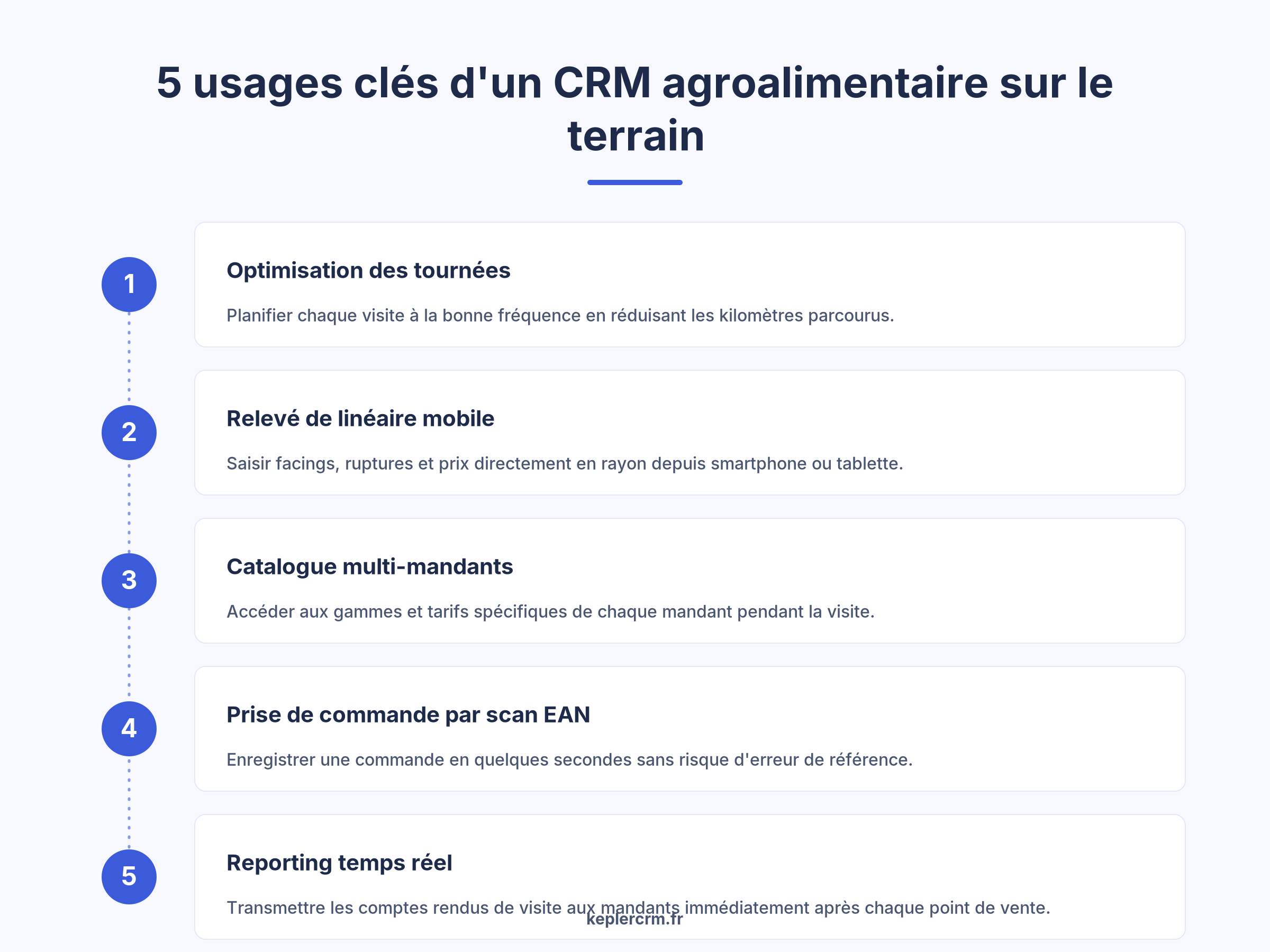
Adopting a CRM built for the food and drink sector changes your day-to-day work in several specific ways. Here is what you gain in practice:
- Optimised sales routes: you plan your visits based on the target call frequency for each sales point and the distance to cover — no unnecessary detours, no forgotten accounts.
- Reliable shelf audits: you record out-of-stocks, observed prices, and facings directly on the shop floor from your mobile or tablet, with no manual re-entry later in the evening.
- Always up-to-date catalogues and prices: your ranges, banner-specific conditions, and current promotions are all centralised in a single tool you can consult during the visit.
- Full history for every sales point: you prepare each call knowing the most recent orders, any issues, and the commitments made during the previous visit.
- Fast order taking: with EAN barcode scanning, you record an order in seconds with no risk of reference or pricing errors.
- Immediate visit reports: your principals receive field information in real time, reinforcing your credibility and added value as a multi-line sales agent.
- Commission tracking: you view your commissions by principal, by product, and by period without waiting for end-of-month statements.
These benefits apply regardless of your sales channel. Whether you work in grocery retail CRM, wholesale, or foodservice, the logic is the same: less administrative time, more face-to-face time with your contacts.
Frequently asked questions
Can a generic CRM be enough in the food and drink sector?
A generic CRM manages contacts and opportunities, but it is not built for shelf audits, banner-specific pricing conditions, or tracking visit frequency by sales point. These are core requirements for sales agents in grocery retail and need a tool designed for food and drink field sales.
Do you need to be a large business to justify adopting a CRM?
No. An independent multi-line sales agent stands to gain just as much as a team of ten sales reps. Managing several principals and hundreds of sales points creates a level of complexity that quickly exceeds what a spreadsheet or paper call book can handle. A tool like KepleR CRM, available at €89 / month excl. VAT all-inclusive, is designed precisely for this profile.
Is there a food & drink CRM suited to independent agents in the UK and France?
Yes. Tools like KepleR CRM are built specifically for independent sales agents and sales representatives, whether they work alone or as part of a multi-line sales agency. They incorporate sales route management, shelf audits, and commission tracking in a single application available on mobile, tablet, and desktop — with no additional cost or extra modules required.
How do you choose between the different CRMs available for food and drink?
Ask three questions: does the tool work on mobile during a field visit? Does it include sales route management and shelf audits? Does it allow you to manage several principals with separate catalogues and pricing? If the answer is yes to all three, you have a tool suited to your reality. KepleR CRM meets all three criteria and offers a complimentary one-hour demonstration so you can verify it for yourself.
Try KepleR CRM for free
Manage your sales routes, accounts, and commissions from your mobile.
Free trialConclusion
The French food and drink market remains one of Europe's largest, but it is also becoming one of the most demanding for field sales teams. With margins at their lowest in decades according to Agreste, the growing importance of data, and rising expectations from principals, the sales agent who still relies on a spreadsheet or paper call book is falling behind in ways that are hard to recover from.
Structuring your sales routes, making your shelf audits reliable, and centralising your customer data are no longer options reserved for large teams: they are fundamentals of the job in 2026. If you would like to see in concrete terms how a food & drink CRM built for the field can transform your working day, try KepleR CRM for free or book a complimentary one-hour demonstration.