
As a multi-line sales agent, your only non-renewable asset is your time. Every hour spent on tasks that add no value is one hour less in front of a client, one fewer order, one fewer commission. According to the State of Sales report by Salesforce (cited by Smappen, 2026), sales reps spend on average just 28% of their time actually selling; the rest goes on administration and organisation. For an independent multi-line agent, this ratio is even more critical — there is nobody to absorb the overflow on your behalf.
Why time management is the central challenge for multi-line agents
By definition, a multi-line sales agent juggles several principals, several catalogues, and several client bases. According to Service-Public Entreprendre (updated February 2026), they act «permanently and independently» on behalf of their principals — with no salary safety net to absorb unproductive days. Every wasted hour therefore has a direct cost on their commissions.
A typical day is split between client appointments, travel, and administrative tasks (devenez-entrepreneur.fr, 2025). The problem: non-sales tasks tend to encroach on the time slots that should be reserved for selling. The pressure increases as the portfolio of lines grows.
A field sales rep can physically meet only 8 to 12 clients per day (oceanesavoy.com, 2025). Every unnecessary journey or duplicate data entry chips away at that ceiling. This is precisely where performance gaps open up between two agents carrying the same lines.
The 7 time wasters to eliminate: a step-by-step method
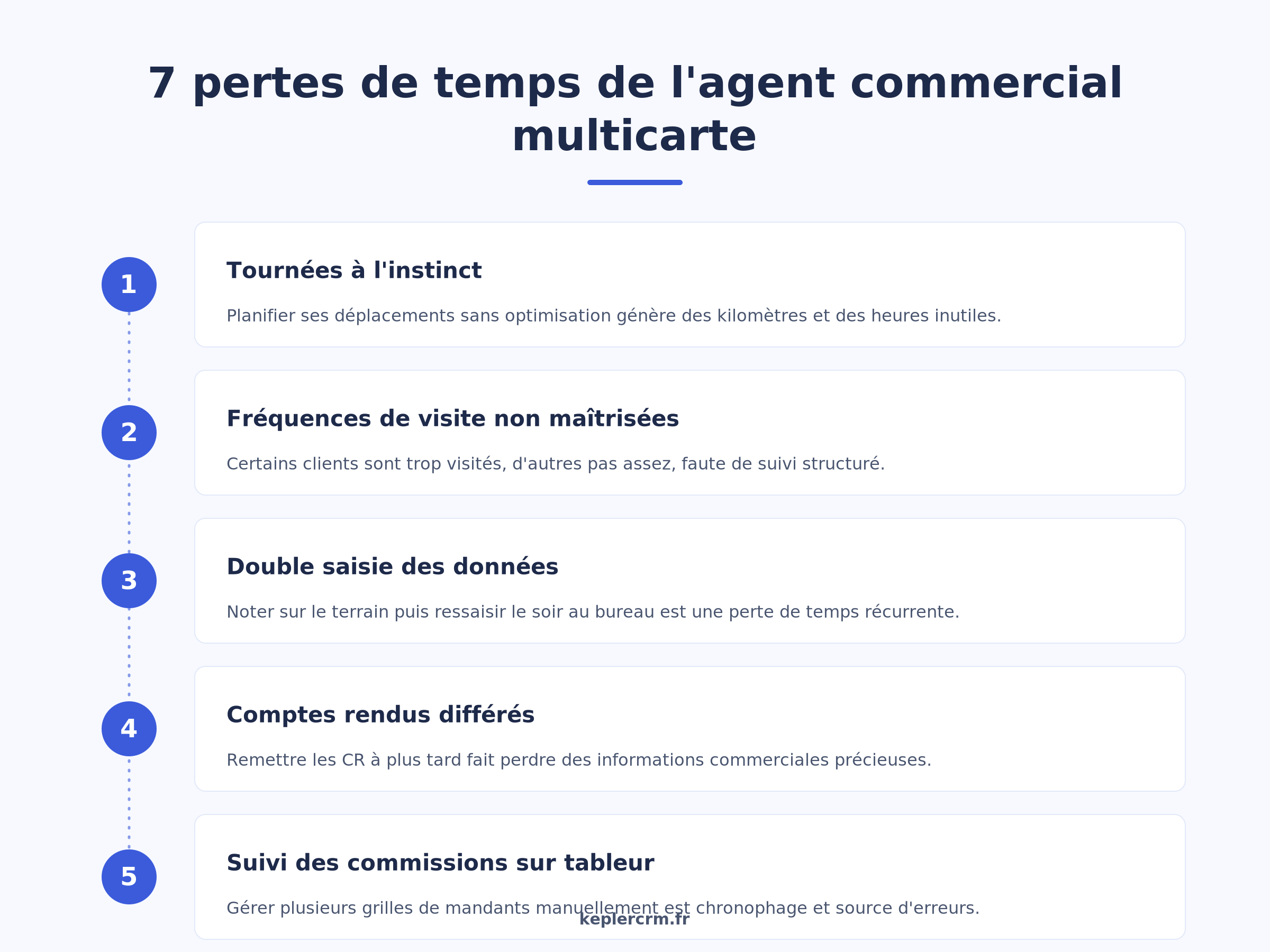
1. Planning your sales routes by hand or on instinct
Mapping out your days on a paper map or in your head generates zigzag journeys and needless kilometres. A poorly prepared route wastes time on the road and leaves visits rushed (Smappen, 2026). The solution: use a tool that optimises the order of visits based on geography and the visit frequency due to each client. KepleR CRM natively includes sales route organisation and optimisation, directly from your mobile.
2. Neglecting the visit frequency for each client
Some clients are visited too often, others not enough. This imbalance creates two simultaneous problems: time wasted on clients who are already won over, and missed opportunities with under-visited prospects. You need to segment your client base by potential and set a target frequency for each segment (data-b.com, 2024). A field CRM automatically flags clients who have not been visited for too long.
3. Entering information twice
Filling in a notebook in the field, then re-entering the same data in a spreadsheet in the evening, is a structural time drain. Every piece of information should be entered once, in the right place, directly after the visit. A mobile CRM lets you log the visit report, the order, and the follow-up in a single action — no desktop re-entry in the evening.
4. Writing visit reports too late
Putting visit reports off until later risks losing valuable information: a promise made to the client, an objection to handle, a market insight. The visit report should be written within minutes of the visit, while the details are still fresh. On mobile, this takes less than two minutes if the fields are well structured.
5. Managing commissions manually in a spreadsheet
Recalculating commissions line by line, principal by principal, at the end of every month is a time-consuming task and a source of errors. With several principals using different rate schedules, a spreadsheet quickly hits its limits. Automated commission tracking, built into the CRM, frees up time and ensures you never miss a payment discrepancy.
6. Searching for product information during the visit
Leafing through several paper catalogues in front of a client, or calling the principal to check a price or availability, undermines your credibility and unnecessarily extends the visit. All catalogues, price lists, and product sheets should be accessible within seconds from your phone. KepleR centralises catalogue and order taking with EAN barcode scanning in a single tool, for all your lines.
7. Not preparing your appointments the evening before
Arriving at a client's without having reviewed the order history, outstanding amounts, or past commitments means missing the chance to sell more and nurture the relationship. Spending ten minutes the evening before on each appointment the following day is one of the best time investments you can make. A CRM centralises the entire client history and makes it readable at a glance.

What you concretely gain by eliminating these 7 obstacles
Removing these time wasters does not produce a marginal gain — it transforms the ratio between selling time and administrative time. Here are the concrete benefits observed:
- More visits per week thanks to optimised routes and shorter journeys.
- Reliable visit reports that build your commercial memory and strengthen principals' confidence in you.
- Better portfolio coverage: no priority client is forgotten, no visit frequency is overdue.
- Commissions tracked in real time, with no end-of-month stress and no risk of an undetected discrepancy.
- A more professional image during visits: catalogue to hand, history known, figures mastered.
For an agent managing three lines or more, these cumulative gains easily represent one to two additional visits per day — a direct and measurable impact on commissioned turnover.
Frequently asked questions
Is a mobile CRM really useful when you work alone?
Yes, even more so. When you work alone, there is no assistant or back office to compensate for missing organisation. A CRM designed for the field replaces several separate tools (diary, spreadsheet, paper catalogue) with a single interface, accessible from your phone, Android or iOS.
How long does it take to get to grips with a new tool of this kind?
CRMs designed for the field — as opposed to tools built for head office — are designed to be up and running quickly. With a one-hour demonstration and a few days of daily practice, the majority of agents are self-sufficient. KepleR offers a free 1-hour demonstration so you can evaluate the tool against your own activity.
Do these methods also apply to multi-line sales representatives?
Absolutely. Whether you are an independent sales agent registered with the RSAC or a salaried multi-line sales representative, the time wasters described here are identical. The difference in legal status has no bearing on the logic of field organisation. KepleR CRM is designed for both profiles.
Conclusion
The seven time wasters listed here are not inevitable features of the job: they are organisational habits that can be corrected one by one. Start with the one that costs you the most — often route planning or duplicate data entry — and build from there. The time you recover goes back where it creates value: in front of the client. If you would like to see how KepleR CRM adapts to your way of working, the free trial is available at keplercrm.fr with no commitment.